Update 8/18/2025
I saw the man himself, Dr. Hansen. He confirmed the diagnosis of SRS. Said it is bilateral which is no surprise considering I can make all the noises with my right ribs that I can make with my left. I even signed up for surgery on 9/17/205, a month from now. Today I have been panicking because I don’t know if I should get the surgery. I am probably a typical case, I’m just concerned that I don’t have much rib pain. It seems to be radiating from the back to the ribs, not vice-versa. Apparently my 10th ribs are floating congenitally and it’s my ninth ribs that have subluxated under my 8th ribs. This should be causing pain near my 8th vertebra but my pain is more at 10/11. I’m worried that my wrecked ab and core muscles are causing my back pain, not my slipped ribs. I’m worried that a lot of people have slipped ribs but not SRS, which I have to conclude is defined as pain from slipped ribs. That’s what I’m not convinced of. I have “slipped ribs” and I definitely have pain (in the places that SRS causes pain). But is the cause of my back pain intercostal nerve irritation from my broken costal cartilage and/or hypermobile ribs? Will it help the back to stabilize those ribs in the front?
I got the surgery date last week but today I started to panic. This surgery, while “minimally invasive”, is no joke. Dr. Hansen told me point blank I should give up the idea of windsurfing again. Recovery can take a year or more and some people end up worse off. He said if I bust it up, it would be difficult to fix. You have to basically grow a replacement rib cage from scar tissue. They cut off the cartilage rib tips and use them for spacers between ribs 8, 9 and 10 and sew the stack together. Then they sew a dissolvable plate on top of it all that turns into “rock candy” after a year for further torment. The pain for the first month is supposed to be pretty bad but unless it irritates my back, it probably won’t be much worse than the pain I’ve had for fifteen years. Bottom line is, I think I have to go for it, especially after all I’ve put my wife through. It will mean a year of giving up all activities and I’ll probably never be able to surf, windsurf, mountain bike or snowboard again but if it gets rid of my pain, it will be worth it. There are lots of horror stories online but like one guy said, the success stories don’t return to the forums, they are out there have fun.
So, I think it’s time to switch over to the Blog. I’m going to be driving myself crazy the next week or so, deciding whether or not I should have this surgery. My wife has encouraged me to listen to the recording I made of my visit with Dr. Hansen and to post on Reddit and Facebook. This is going to be the hardest decision I’ve ever made in my life.
————— end of Update —————————
The following is kinda like the homepage. It debates the existence of Slipping Rib Syndrome and whether it is symptomatic for me. Can you have SRS without pain? Is pain what makes “slipped” ribs a syndrome?
What if I have SRS but it’s not what’s causing the knife in my back?
This is my biggest concern. What are the alternatives?
- Facet Joint Syndrome – I did rush into a Z-joint nerve ablation at T9/10 or T10/11 out of desperation many years ago (with mixed results). Check this out! Could this be causing the knife in my back? Amongst my many “accidents” is a volleyball overextension in the 1990s. I was sore for years afterward but I never went to the doctor because it was more of a dull ache and I knew what it was from. It eventually healed but what if this is an old injury come back to haunt me? The results of my rhizotomy were mixed and hard to gauge, much like my injections. It seemed to irritate other nerves, possibly the 10th intercostal nerve. For about an hour after the pocedure my entire left side was swollen up like I had a football underneath the skin. Perhaps it was my 10th intercostal nerve, damaged by the fire next door. I would have different kinds of pain after that but it did seem to take away the stabbing for a couple of years. Maybe. That’s one of the problems I have. Nothing is certain. My memory is bad and results were never clear to begin with. Facet Joint Syndrome was my first diagnosis for this problem 15 years ago. Could Facet Joint Syndrome be causing the knife in my back?
- Wrecked core, especially 10th dermatome: I blew a hole through the middle of my rectus abdominis around 2000. I had surgery in 2003 but because it was a clean tear through the middle of the muscle, the surgeon just stitched it up. I proceeded to rip those stitches out almost immediately while windsurfing in the Columbia River Gorge. Ok, not immediately. I waited the recommended time before resuming full activity. I just don’t think they knew the activity I had in mind. While I did have pain there for years afterward by the time my current pain appeared in 2010, I had forgotten about it. It is still controversial as to whether there is a connection between the hernia and my current pain. I believe there is definitely some connection. There was a study done that showed a connection between weak abs and SRS. My left ab was more than weak, it was destroyed. I had surgery again in 2019 which revealed significant, long-term damage requiring mesh and diastasis repair. So my left core muscles have been through hell and are still sore. Could this be causing the knife in my back? Click here and here. One question continues to haunt me. If the back pain is referred pain, is that pain originating in the ripped up rectus abdominis? Here is an article that talks about Dr. Hansen and the three criteria for diagnosis, one being localized pain at the point of subluxation. I’m just not sure how much of that I have!
- Osteitis/arthritis: A Stanford radiologist who specializes in imaging for pain did an experimental scan on me using a different radiotracer, FTC, but one that behaves very similar to FDG. This showed a number of osseous issues, suggesting an auto-immune illness. Namely abnormal uptake in the vertebral marrow of T9-12 and the costotransverse/costovertebral joints. He felt these were significant pain generators. What if my supposed autoimmune illness is causing the knife in my back? It’s a long story but I might have developed PMR/GCA although if I have I suspect it’s from 15 years of chronic pain. What if that volleyball injury decades ago set me up for arthritis in that area in future years?
- Then there’s the GI issues. When the pain first started, I seemed to notice it more after drinking a cup of coffee. At the time, the late 2000s, I was drinking too much, eating poorly and working too much with bad posture. I was crashing a lot on my mountain bike, surfboard and other activities. I knew I was headed for trouble if I didn’t get healthy. That’s when the pain started. I didn’t really make the connection between diet and pain at the time so I purchased an espresso machine. This would prove to be my downfall. After drinking about 10 espressos a day while working my pain got worse and worse. Finally I realized it would worsen shortly after eating. I made the GI connection. Now I know that drinking coffee, eating spicy foods, taking medication on an empty stomach, can all exacerbate the pain drastically. Sometimes I think I just have an ulcer. I have an appointment with a GI doctor next week but I don’t expect him to find anything. They never do. But I’ve never ruled out a GI problem or some other visceral issue (e.g. pancreatitis, duodenitis) as the primary source of the pain.
This costal cartilage reconstruction surgery, while called minimally invasive, is no joke. It’s a long, painful recovery and my nerves are already on fire. I suppose I’m desperate enough to try anything but I hope this light is the end of the tunnel and not an oncoming train.
3-D Rendering
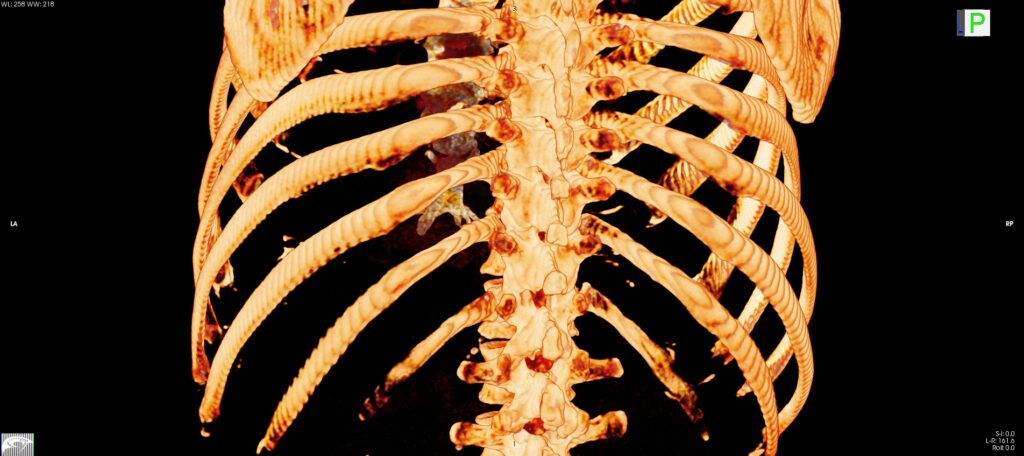
I’ve been playing with a 3-D rendering app called Zoros but I’m not sure I trust it. At first I was excited because I thought it showed my missing cartilage but now I think it’s just how rendering software treats cartilage. It takes a wild guess. Here is what mine looks like…
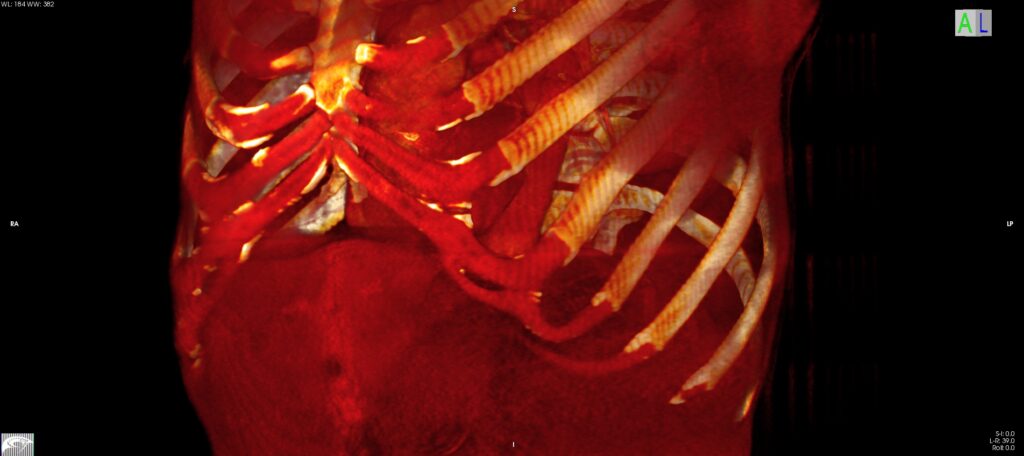
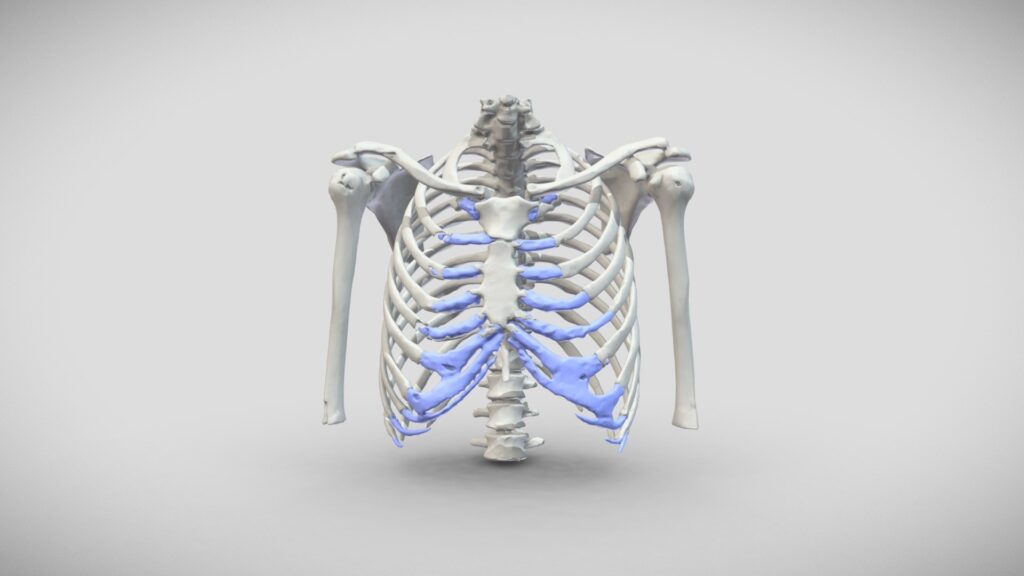
You can see that the 10th rib is basically floating and the 9th rib cartilage looks like it’s broken loose from the 8th. However almost every 3-D rendering I’ve seen of “normal chests” look like this. I think the bottom line is, you can’t detect SRS from a CT scan. You can see other problems such as rib head dislocation (it looks like my right 12th rib is subluxed but I don’t have pain on the right). Anyway, here’s an example of a “Normal Chest”….
I do want Dr. Hansen to look at my right 12th rib. Check this out…
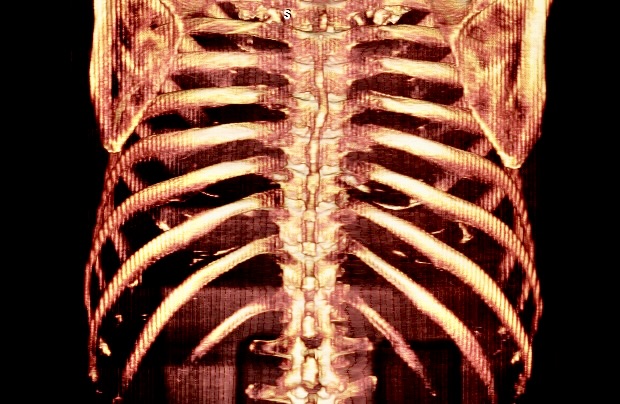
Here’s another…
Like I say, it looks like the Right 12th rib is subluxed but I don’t have any pain on the right! My pain is also higher, up around T10, about an inch from the spinous process. Pushing on the end of the transverse process hurts like hell. Or maybe it’s the tubercle of the rib.
Check out this inflammation. It looks to me like it’s over the transverse process or rib tubercle of the 9th and 10th ribs…


Evidence
Hooking Maneuver: Positive
When performing the hooking maneuver, the 10th rib appears to be folded under the ninth rib. Pulling downward and outward (feels like unfolding), the 10th rib can be pulled back into place with an audible thud that can be heard across the room as well as felt by the practitioner as well as the patient. This triggers a familiar pain in the flank that radiates to the two primary pain locations in the front and back (i.e. it recreates “the Pain”). When the hook is released the rib immediately subluxates (i.e. folds back under the ninth rib). I believe my 9th rib is subluxed as well. I may even have a broken cartilage fragment floating around. I expect Dr. Hansen will find multiple problems when I see him August 12th.
MO
- Easily and definitively diagnosed with hooking maneuver (patient tested strong positive)
- Most commonly affects the 10th rib (the knife in my back is left of my 10th vertebrae)
- Would explain why it has remained undiagnosed for 15 years (this is a rare/underdiagnosed condition)
- Cannot be seen with x-rays, CT, MRI or standard ultrasound. Requires dynamic ultrasound
- Refers pain to the intercostal nerve root between the 9th and 10th vertebrae, exacerbated by pushing on the end of the left transverse process (or rib tubercle).
- The condition often accompanies a history of physical trauma.2 (my ribs have been a piñata, slamming into windsurfing booms for decades, not to mention many other traumatic injuries to my ribcage including mountain biking, snowboarding and numerous watersports). It is a common injury for windsurfers and big-wave surfers.
- The condition is known to accompany hypermobility (the patient is hypermobile)
- It refers to both the mid-back and the chest (same for patient)
- It comes and goes but comes on sharp and stabbing and fades to aching (same for patient)
- SRS is associated with a weak rectus abdominis muscle (click here for the study). Mine was herniated and repaired twice and my entire core on the left side is out of alignment. While most doctors are skeptical of a connection, I believe there most certainly is one. The knife in my back and the hole in the front are both in the 10th dermatome. It’s as if they are mirror images of each other.
Connection to Herniated Left Ab
My Story
I have been in severe, chronic pain for 15 years. Prior to 2010 when it began, I lived with pain as an extreme sports athlete, constantly injured from surfing, windsurfing, snowboarding, mountain biking, motocross and other sports. However the pain that I’ve been battling for over a decade is on a whole other level, more severe than anything I could have imagined before. The pain is constant and wavers between level 3 and level 10. Trying to get help from the US medical system has been a nightmare. I am a disabled engineer. I had to stop working in 2012 because the pain was so severe I couldn’t think straight. It hurt too much to eat. I lost so much weight people were concerned I was dying. In truth I was. I was screaming inside, but nobody was listening. This was before the DEA’s war on pain patients so I was able to get opiates, but even fentanyl patches didn’t relieve the pain. Thankfully I’ve learned to manage it with the help of a doctor who puts her patients first, who still has some empathy and is willing to prescribe methadone, a drug known to be very effective for nerve pain at a low dose. Most doctors won’t do this for their patients and many patients are suffering needlessly and even committing suicide. I do plan to battle this politically once I get my own case under control.
Every day for 15 years, I have been trying to figure out what is hurting me; what is causing the knife in my back just left of my 10th vertebrae? Or the spear that goes all the way through to my xiphoid process. What is the unknown thing inside me that has ruined my life, that is so painful you can see the inflammation all over my left mid-back with the naked eye?
Mystery Solved?!
I think I finally figured it out on my own. I believe my 9th intercostal nerve (left) is being irritated by a subluxated 10th rib, much like in the photo above (actually the photo shows the 7th intercostal nerve being irritated by the 8th subluxated rib). SRS affects the “false ribs”, 8, 9 and 10. But if the 8th rib subluxates, it can irritate the 7th intercostal nerve. My pain near the spine seems closer to T10 so I am trying to find a doctor to give me intercostal nerve blocks on nerves 9 and 10, or preferably, 8, 9 and 10, although any injection above 9 has always felt too high.
I may not have Slipping Rib Syndrome but the “hooking maneuver” produces an unmistakable positive result. I can pull my 10th rib out from under my 9th rib (i.e. back into place), and when I let go, it falls back out of place with a thud, into my ninth rib. This is supposed to be a definitive test and I pass it with flying colors. I think my costal cartilage is probably a wreck. My ribs have been a piñata over the years with all my sports, including windsurfing, surfing, snowboarding and mountain biking where I had numerous crashes. This condition is especially common among windsurfers because at extreme speeds, you are often catapulted by a 15′ mast with extreme force. Stuck in the harness, your ribs crash onto the exposed boom. The prime suspect however is the extreme force that a windsurfing harness puts on the floating (11,12) and false (8-10) ribs. I don’t know if it’s responsible for the breaking of my costal cartilage, but once, subluxated, it was really irritating my intercostal nerves (I suspect 9th and 10th). The biggest mistake I made was not stopping when it started to hurt. My life was so wrapped up in extreme sports, I couldn’t stop. I kept going until I was in so much pain I couldn’t move. Perhaps if I had stopped when it started hurting it would have healed and not progressed to the point of debilitation. Now however, we’re past that point. I’ve been disabled for 15 years and it’s time to try anything. I’ll probably never be sure that costal margin reconstruction will have any effect on the Loch Ness Monster until I try it. I’m desperate enough to try anything so I will place my life in the hands in Dr. Hansen and do whatever he recommends. In the meantime, I’m going to read success stories and look for others who presented mostly with back pain.
Here, is a list of websites and YouTubes that I’ve found informative.